Many try to calculate how much SEO can grow their traffic and sales. But how many try to simulate how much an SEO f***up can cost in lost sales?
I have worked with SEO since 2019, for eCommerce, B2C and B2B brands in Finland, Sweden and internationally. One thing I have learned is that the growth forecast is only half of the picture. The other half is what happens when something breaks and no one notices.
In this article I go through why we calculate the ROI of SEO in the first place, why those forecasts are always a bit wrong, and what the cost of SEO f***ups looks like when you simulate it on a real case.
Why we calculate the ROI of SEO
“What is the ROI of SEO?” is one of the most common questions I get. It usually comes from a growth manager, a sales manager, a client or a potential client who needs to justify the investment.
It’s a fair question, because SEO doesn’t work like paid media. SEO and content marketing don’t scale linearly with the investment, and they don’t accelerate overnight. But once the organic traffic starts coming, you don’t pay per click. That is when SEO starts to pay for itself and gives you:
- Long-term “free” sales
- A buffer against rising media costs
- More trust, since many users skip the ads and click on the organic results
- Better results from your other marketing channels
- A more usable website
- More brand visibility and authority in Google searches
- Expert content that gets referenced and builds brand value
- Visibility in AI search, where AI assistants pick up your content and brand when they answer and recommend
How SEO growth forecasts are made
When I forecast the potential of SEO, I start with a keyword analysis of the searches that matter for the business. Then I use search volume, ranking positions, click-through rates from Google, conversion rate and average order value to calculate how much traffic and revenue better rankings could bring.
The numbers grow more easily on a website that has never invested in SEO, since there are more low-hanging fruits to pick. On a site that has already worked with SEO for a few years, growth is slower, because the easy wins are already taken.
And here is the honest part: the forecast will be wrong however you calculate it. Click-through rates change with every new feature in the search results, AI answers take clicks, competitors move and Google updates its algorithms. A forecast shows the direction, not a promise.
The forecast nobody makes
What we seldom take into consideration in these calculations is the potential SEO f***ups. And they can happen whether you invest in SEO or not.
Without an SEO keeping an eye on your site’s SEO health, something unexpected but severe can happen and cause a major loss in revenue. If it isn’t a Google update, it’s usually something technical breaking without anyone noticing.
If no one is watching Search Console, analytics or rankings, a slow decline can go unnoticed for a long time. And recovering organically takes time. Every day until it’s fixed, and every day of the recovery, you lose sales because of the f***up.
Simulating the cost of SEO f***ups on a real case
I simulated this on a real case: an established business with clear seasonality and a big peak every November. The chart shows three scenarios over two years:
- Traffic if we keep working: an SEO keeps working on the site, and traffic grows about 5% on top of the normal level.
- Traffic as usual: the site’s normal traffic, with its seasonal ups and downs.
- Traffic if you keep messing up: the business stops investing in SEO, which means no one is looking at the website from an SEO perspective and quickly identifying when things break.
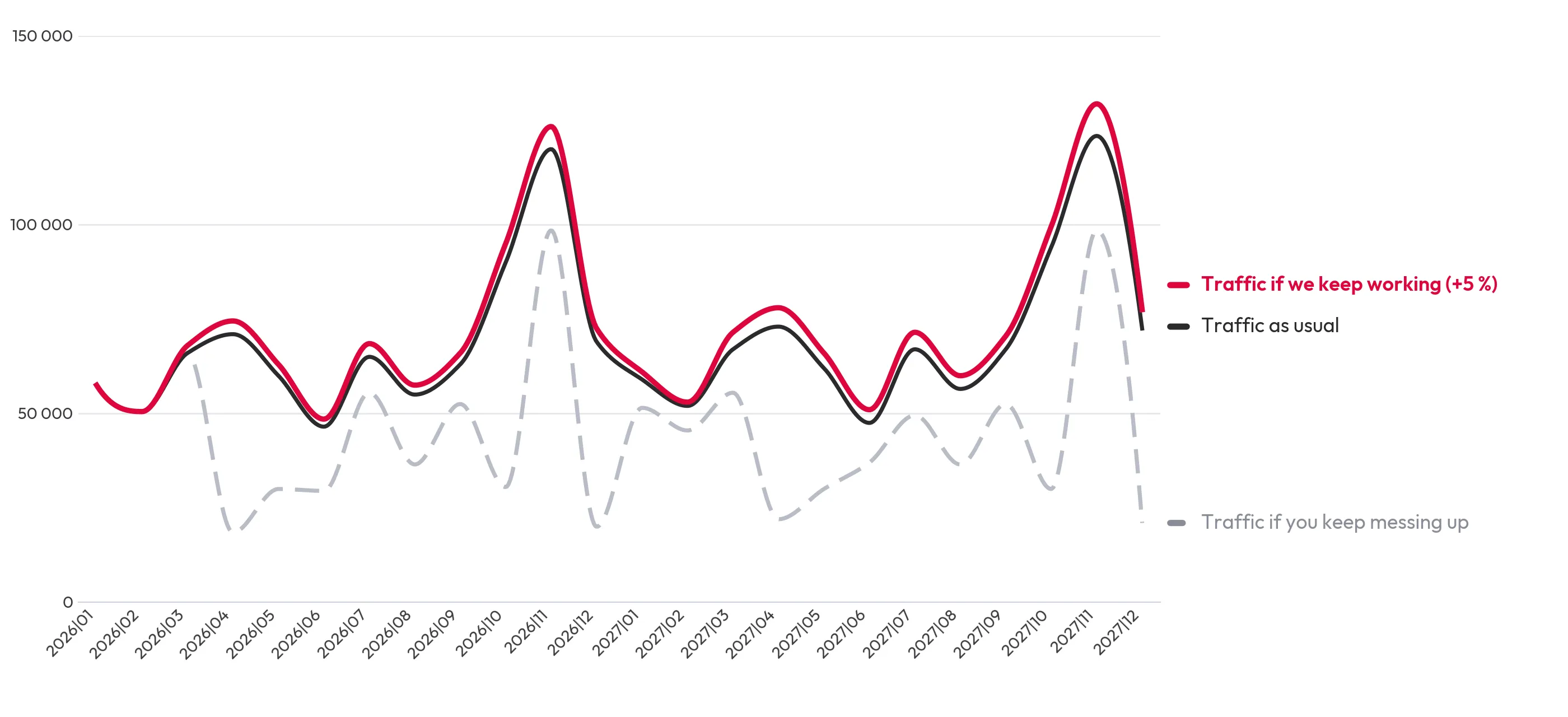
In the f***up scenario, traffic doesn’t just slowly fade. It drops sharply, in the worst months to around a quarter of the normal level, recovers partly, and then drops again when the next thing breaks. Even the November peaks end up about a fifth lower than usual.
The gap between the lines is loss. And notice the difference in size: the upside of keeping an SEO on the site is a few percent, but the downside of having no one watching is many times bigger.
Technical SEO errors that can go unnoticed
And things do break sometimes, especially in site updates. These are all real technical SEO errors I have fixed on real websites. They have caused sudden drops in rankings, or kept a site from ranking better:
- Front page canonical on every page. Google may treat every page as a duplicate of the front page and drop them from the index.
- Google product organic listings get disapproved. Your products disappear from the free product listings in Google.
- Hreflang gets broken. The wrong language or country version starts ranking, or the versions compete with each other.
- Noindex gets broken and millions of parameters get indexed. Google spends its crawling on thin duplicate URLs instead of the pages that sell.
- JS and CSS resources get blocked in robots.txt in a site update. Google can’t render the pages the way users see them.
- All redirects go to the front page. Google treats them like soft 404s, and the value of the old URLs is lost.
- 302 redirects (temporary) instead of 301 redirects (permanent). It can take longer for the rankings to move over to the new URLs.
- Menu links not added to the source code. If the navigation only exists after JavaScript runs, Google has a harder time finding and valuing your most important pages.
- Blocking Google bots in robots.txt. Google can’t crawl the pages, and they start losing rankings.
- Google can’t read product reviews. You lose the review stars in the search results, and with them clicks.
- AI bots can’t read product reviews. AI assistants can’t use your reviews when they compare and recommend products.
Etc. etc.
Why these f***ups go unnoticed, and how to catch them
Most of these errors don’t show on the website. The pages look exactly the same to users, so no one in the company reacts. The damage happens in how Google and AI bots see the site.
They also tend to come with site updates, platform migrations and new releases, when developers change templates, redirects or robots.txt without anyone checking the SEO side. And the decline is often slow at first, so it’s easy to blame seasonality or the market.
To catch them early, someone needs to:
- Check Search Console regularly for indexing, crawling and product listing issues
- Crawl the site after every bigger release or migration
- Track rankings and organic traffic for the most important pages and categories
- Be part of the release process, so SEO is checked before things go live, not after
Stopping SEO doesn’t stop the risk
The good thing about SEO is that the results last for years, even if you stop the work and cut the costs. That is a big part of why the ROI of SEO grows over time.
But stopping doesn’t freeze your rankings where they are. Competitors keep improving their SEO, Google keeps changing, and your own website keeps changing too. When no one is watching, a single f***up can cost you more in lost sales than the SEO work you saved on.
Have you experienced other technical errors that caused severe problems for a website’s rankings? Let me know, I’m happy to add them to the list.